


Last reviewed October 29, 2026 · 7-minute read
The short answer: The FDA plans to propose a rule, expected in November 2026, that would name specific fragrance allergens brands must list on cosmetic labels instead of hiding them under "fragrance" or "parfum." Until then, the simplest move for reactive skin is to choose products labeled fragrance-free (not just "unscented"), read the full ingredient list, and test anything new before it goes on your face.
For decades, one word on an ingredient list has done a lot of quiet work. "Fragrance" (or "parfum") can stand in for a blend of individual scent ingredients, and as a shopper you have had no way to see which ones are inside. For most people that is a non-issue. For anyone whose cheeks sting, flush or itch after a new moisturizer, it is the single most frustrating line on the bottle.
That may be about to change. Federal regulators have put fragrance allergen labeling on their near-term calendar. Below, we explain what has actually been announced (and what has not), how to decode today's labels, and the fragrance-free formulas our team keeps reaching for at DermStreet.
What is the FDA's fragrance allergen labeling rule?
The rule comes from the Modernization of Cosmetics Regulation Act of 2022 (MoCRA), which directs the FDA to require that fragrance allergens be disclosed on cosmetic labels. In its 2026 Regulatory Plan and Unified Agenda, released July 3, 2026, the agency listed a Notice of Proposed Rulemaking on fragrance allergen disclosure with a target date of November 2026. The proposal would identify the substances that must be disclosed as fragrance allergens on product labels.
The same agenda lists a second November proposal that would ban formaldehyde and formaldehyde-releasing chemicals, such as methylene glycol, in hair smoothing and straightening products that are heated during use.
Is it law yet?
Not yet. A proposed rule starts the formal process; it is not binding. Once it is published there will be a public comment period, and the FDA will then decide whether to adopt, change or withdraw it. Agenda dates can also slip. As of today, the official list of allergens and any concentration thresholds have not been published, so be wary of anyone who tells you exactly which ingredients will be on it.
What does this change for you right now?
Nothing on the shelf changes overnight. What changes is the conversation: shoppers are getting better at reading labels, and it pays to know what to look for. You may already notice individual scent components such as linalool or limonene spelled out on some ingredient lists, often alongside essential oils. Those names are worth knowing if you are sensitive.
Why does fragrance bother some skin?
According to a Cleveland Clinic dermatologist, fragrances are a very common cause of contact allergies. They can also oxidize into more irritating compounds once they are on your skin. That is why dermatologists commonly suggest fragrance-free products for skin that is dry, sensitive, acne-prone or eczema-prone, even if you have never had a reaction. Prevention is easier than calming a flare.
Fragrance is not the only culprit. The American Academy of Dermatology (AAD) notes that more than 15,000 substances can cause an allergic skin reaction, which is why a dermatologist may recommend patch testing if a rash keeps coming back.
Fragrance-free vs. unscented: what is the difference?
| Label term | What it tells you | Best for reactive skin? |
|---|---|---|
| Fragrance-free | The product is marketed as having no fragrance | Yes, the AAD's preferred choice |
| Unscented | The product has no noticeable smell; the label alone does not tell you how | Not ideal; the AAD advises choosing fragrance-free instead |
| "Fragrance" / "parfum" on the list | An undisclosed blend of scent ingredients | Skip if you are prone to reactions |
| Essential oils, linalool, limonene | Botanical or individual scent components | Use caution and test first |
The AAD's guidance is direct: to reduce the chance of irritation, choose fragrance-free rather than unscented products, and for sunscreen, if the label says "unscented," choose another one.
Who should go fragrance-free (and who can skip it)?
Worth prioritizing if you:
✔ Flush, sting or itch easily
✔ Have dry, eczema-prone or rosacea-prone skin
✔ Are rebuilding a stressed barrier after a retinoid, peel or in-office procedure
✔ Have had a reaction you could never trace
✔ Are breakout-prone and want fewer variables
Probably fine to skip if: your skin tolerates everything and you love a scented ritual. Fragrance is not automatically "bad." It is simply an unnecessary variable when your skin is unpredictable. If you love perfume, the Cleveland Clinic suggests spraying it on clothing rather than skin.
The Best Fragrance-Free Picks to Try at DermStreet
Deals current as of October 29, 2026. DermStreet discounts vary by brand, take one code per item, and may change.
We read every label below. One is explicitly described as fragrance-free; the others list no fragrance, parfum or essential oils in their ingredients on DermStreet's product pages.
Moisturizers for reactive skin
-
EltaMD Skin Recovery Lightweight Face Moisturizer — Described as free from fragrance and parabens, with squalane, panthenol, sodium hyaluronate and vitamin E in a weightless texture that sits nicely under sunscreen.
Deal at DermStreet: 25% off with code SPOOKY25 -
EltaMD Barrier Renewal Complex — A ceramide-rich cream (with cholesterol, squalane and niacinamide) that helps support a stressed barrier, with no fragrance in its listed ingredients.
Deal at DermStreet: 25% off with code SPOOKY25 -
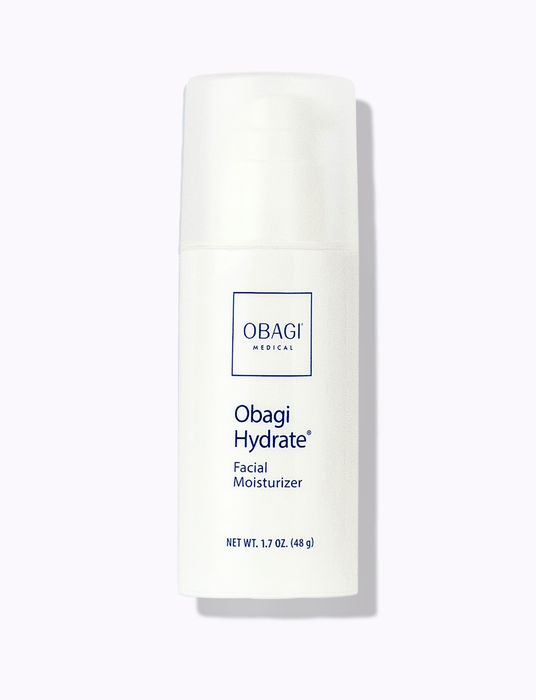
Obagi Hydrate Facial Moisturizer — Shea and mango seed butters plus soothing panthenol, allantoin and bisabolol for comfortable all-day hydration; no fragrance appears on its ingredient list.
Deal at DermStreet: 30% off with code SPOOKY30
Sunscreens with no listed fragrance
-
EltaMD UV Sheer Broad-Spectrum SPF 50+ — Zinc oxide (15%) and octocrylene (10%) in an oil-free, sheer finish that layers well under makeup.
Deal at DermStreet: 25% off with code SPOOKY25 -
TiZO Ultra Zinc Mineral Sunscreen SPF 40 Non-Tinted — A 20% zinc oxide mineral formula designed not to clog pores, for face and body.
Deal at DermStreet: 30% off with code SPOOKY30
Shop All Sensitive Skin Care →
How to build a fragrance-free routine
Morning: Gentle cleanse with lukewarm water → lightweight fragrance-free moisturizer such as EltaMD Skin Recovery → broad-spectrum SPF 30+ like EltaMD UV Sheer or TiZO Ultra Zinc. Reapply sunscreen every two hours outdoors.
Evening: Gentle cleanse → any treatment your skin tolerates → a richer barrier cream such as EltaMD Barrier Renewal Complex or Obagi Hydrate.
Test before you commit. The AAD recommends applying a new product to a quarter-sized spot, like the inner elbow, twice a day for seven to 10 days. No redness, itching or swelling? You can start using it. If you react, gently wash it off and stop. If your skin is already reacting, our winter barrier repair guide walks through a calming reset, and our bemotrizinol explainer covers the other big FDA story in SPF this year. Browse more moisturizers, sunscreens and ceramide formulas.
Frequently Asked Questions
When will fragrance allergens have to appear on U.S. labels?
The FDA plans to publish a proposed rule in November 2026. After a public comment period, the agency decides whether to finalize it, so labeling requirements and deadlines are not set yet.
Which ingredients count as fragrance allergens?
The FDA has not published its list yet. Until it does, read labels for "fragrance," "parfum," essential oils and named scent components such as linalool or limonene.
Is "unscented" the same as fragrance-free?
No. The AAD recommends choosing fragrance-free over unscented products when you want to lower the chance of irritation.
Does fragrance-free mean hypoallergenic?
Not necessarily. Many substances besides fragrance can trigger reactions, so test new products and see a dermatologist about patch testing if rashes keep returning.
Is fragrance in skincare bad for everyone?
No. Many people use scented products without problems. It matters most for dry, sensitive, acne-prone or eczema-prone skin, where dermatologists often recommend fragrance-free.
Where can I buy fragrance-free skincare?
DermStreet.com carries authentic physician-grade skincare, including fragrance-free moisturizers and sunscreens from EltaMD, Obagi and TiZO, and our licensed estheticians can help you choose. Current deals: 25% off EltaMD with code SPOOKY25, and 30% off Obagi and TiZO with code SPOOKY30.
The Bottom Line
Fragrance allergen labeling is coming to U.S. cosmetics, but the official list is still pending, so your best tools today are the label and a seven-to-10-day test. If your skin reacts easily, build your routine around fragrance-free basics, and pick them up at DermStreet while EltaMD is 25% off with SPOOKY25 and Obagi and TiZO are 30% off with SPOOKY30. Our licensed estheticians at DermStreet can help — call 888-249-2502 or start a live chat.
Shop The Blog




Sources
ChemLinked: US FDA Sets November 2026 Timeline for Formaldehyde Ban and Fragrance Allergen Rule
Certified Cosmetics: FDA Proposes New Cosmetic Rules on Formaldehyde and Fragrance Allergens
American Academy of Dermatology: Rosacea Skin Care Tips
American Academy of Dermatology: How to Test Skin Care Products
American Academy of Dermatology: Patch Testing
Cleveland Clinic: The Worst Skin Care Products and Ingredients
This article is for educational purposes and is not medical advice.